
Montsuki-hakama
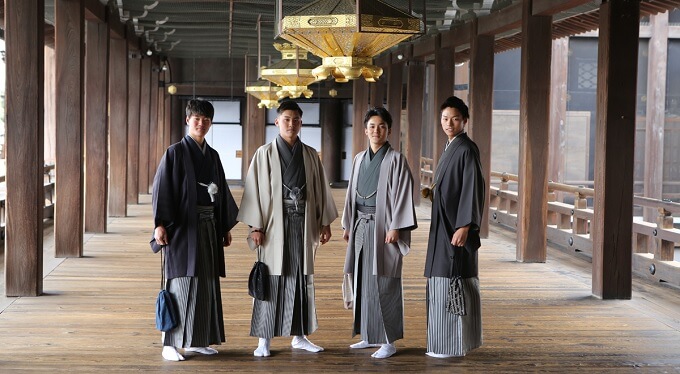
The mon-tsuki hakama is the most formal attire!
The mon-tsuki hakama (mon-tsuki haori and hakama) is the most formal attire in traditional Japanese men's clothing. It consists of a "mon-tsuki haori"—a haori jacket featuring family crests on five locations (the back, both sleeves, and both chest areas)—paired with striped "hakama" pants.
The family crest is a unique emblem with a long history in Japan, used to represent individual family lineages, bloodlines, and social status. Mon-tsuki hakama is still worn today by grooms at weddings, as well as during coming-of-age ceremonies and graduation ceremonies.
During the Edo period(from 1603 to 1868), the mon-tsuki hakama served as everyday attire for samurai and formal wear for commoners. Samurai wore family crests to distinguish friends from enemies on the battlefield, displaying them on swords and armor. Even in daily life, they wore family crests on their haori jacket and kimono to indicate their family name and lineage.
In the early Edo period, when commoners wore mon-tsuki hakama as formal attire, these garments were typically in subdued colors. By the mid-Edo period, however, black mon-tsuki haori and hakama had become the most formal attire, and black is still considered the most formal color today.
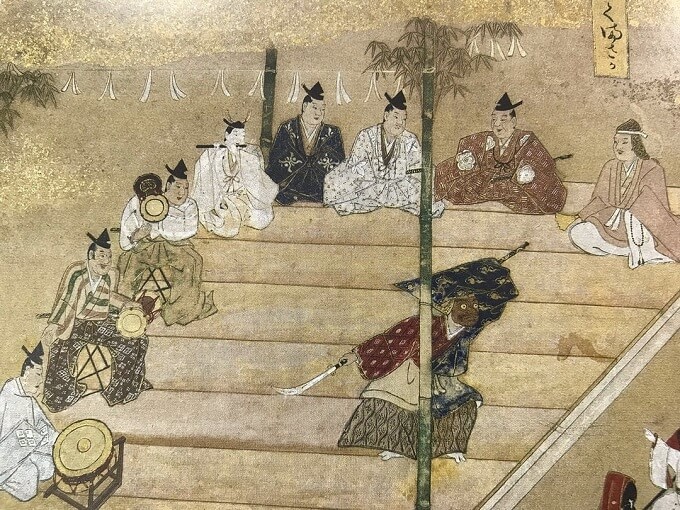
Although commoners did not have family crests during the Edo period, family crests became widespread among the general public in the Meiji era(from 1868 to 1912), when commoners were permitted to adopt surnames.
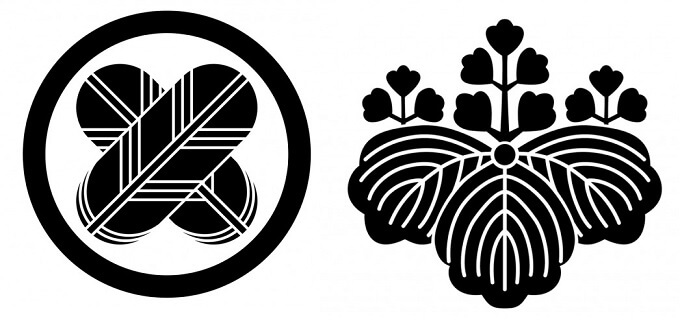
Nowadays, fewer families have their own family crests, and even when they do, the individual may not be aware of it. In such cases, a standard crest known as a "tsūmon" is used. For rental kimono and hakama, designs such as the "Gosan-no-kiri" (five-and-three paulownia) and "Maru-ni-tagai-taka-no-ha" (circle with interlaced hawk's feathers) are commonly used. If you wish to add your own family crest to a rental mon-tsuki hakama, you may opt to attach a sticker-type "patch crest."
There is also semi-formal attire called Ryaku-reisou, which allows for a slightly more casual look than the most formal attire. Many people wear it when attending tea parties or as guests at weddings. Semi-formal attire offers flexibility, allowing you to mix and match pieces to suit your personal taste. For this reason, it is also popular among young people attending graduation ceremonies and coming-of-age ceremonies.
For semi-formal attire featuring a mon-tsuki hakama, it is customary to wear "iro-habutae" and style it in a bright, fresh manner. Iro-habutae is a solid-colored version of "habutae," a fabric made by twisting two warp threads together.
Unlike the formal attire featuring five family crests, semi-formal mon-tsuki hakama typically feature three crests, though some may have just one. It is common to pair semi-formal mon-tsuki hakama with solid-colored hakama, and you can choose any color that matches your kimono or haori.
If you want to wear a traditional mon-tsuki hakama in Japan, you can rent one from a specialty kimono rental shop. At shops in tourist areas, you may be able to walk around town or take photos while wearing a hakama.
 Opening Lake
 April Fool's day
 Hanami
 Baseball