
- Top
- Entertainment
- Munetaka Murakami's early life and NPB career
Munetaka Murakami's early life, childhood and career in Japan
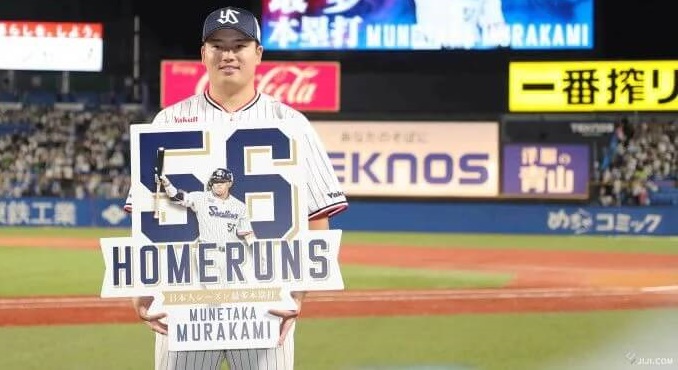
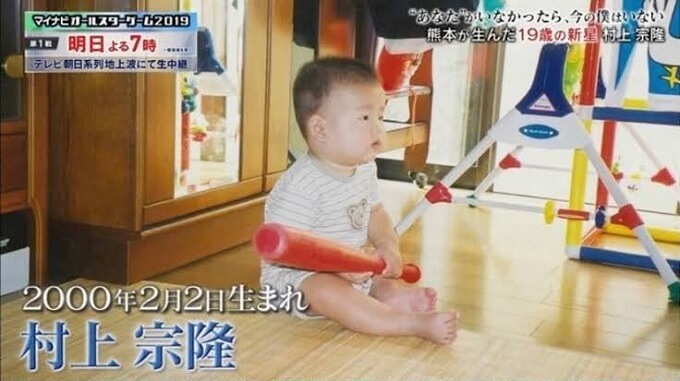
Munetaka is the only Japanese player to hit 56 home runs!
Munetaka Murakami(村上 宗隆 in kanji) was born on February 2, 2000, in Kumamoto City, Kumamoto Prefecture, Japan. His father played baseball until high school, playing shortstop, but had to give it up due to injury. His mother was an attacker on the volleyball team through high school.
Raised by such parents, Munetaka was already swinging a plastic bat at home by the time he entered kindergarten at age three. Though right-handed, he would swing the bat left-handed too, without anyone teaching him. His father said, "He probably watched videos of Japanese Major Leaguers like Ichiro and Hideki Matsui and tried to imitate them." At age four, his older brother took him to join a local sports club. On his first day, he got a nosebleed after failing to catch a ball during catch, but with his father's encouragement, he kept practicing.
On the other hand, he took various lessons during his childhood. From the lower grades of elementary school until graduation, he attended Japanese calligraphy classes with his older brother at his mother's urging. His mother taught him that calligraphy reveals the writer's feelings and conveys them to the reader. In the same classroom, he also learned the abacus called Soroban in Japan, honing his calculation skills. Furthermore, he took swimming lessons and swam relentlessly during that time.
Munetaka joined his elementary school baseball team in fourth grade, quit swimming, and threw himself wholeheartedly into baseball. His father vividly remembers him practicing his swing in their backyard until he was satisfied. He insisted on practicing swings rather than tee batting, sometimes starting to swing his bat the moment he got home after a game. This eventually became a daily routine that continued into high school. At times, he would swing for an hour, his ears tuned to the sound of the bat, swinging with single-minded focus.
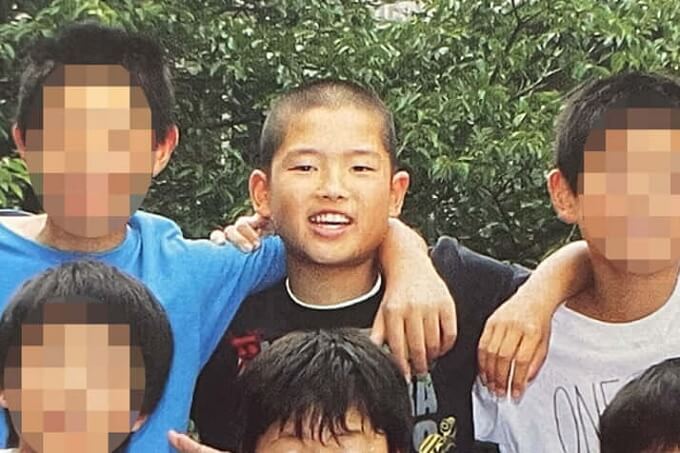
Even then, Munetaka's father, who had played baseball himself, never gave technical instruction. His father strictly enforced the basics for children—"Eat well, sleep well"—and was strict only about table manners, greetings, and responses. Regarding baseball, he told him only to cheer on his teammates from the bench. Because cheering from the bench has no ups or downs.
Even without technical guidance from his father, Munetaka steadily improved his baseball skills. During one game in elementary school, he hit back-to-back home runs in consecutive at-bats—the first to left field, the second to center field. When the coach jokingly told him before his third at-bat, "Now hit it to right field!", he did exactly that, sending the ball into the right-field stands and astonishing the coach.
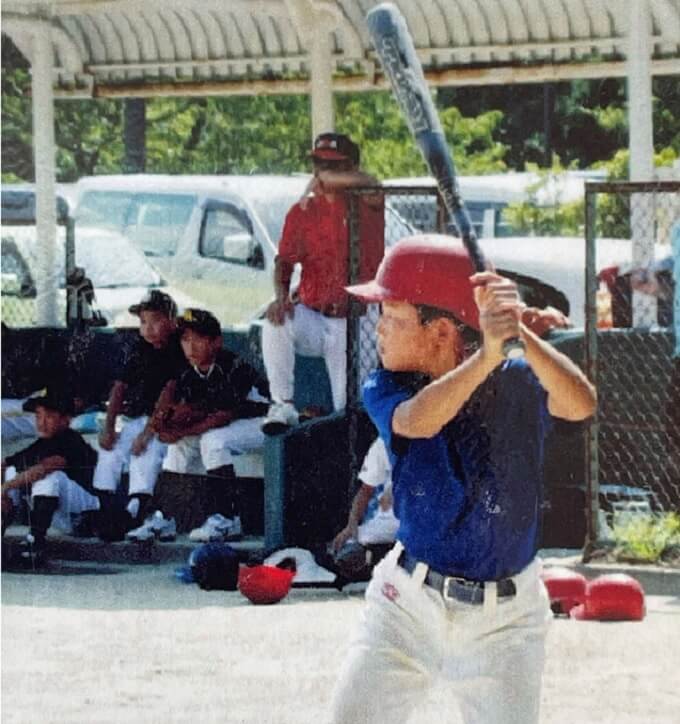
When he entered sixth grade, he joined the Kumamoto Higashi Little League club team. Mr. Yoshimoto, the coach at the time, recalled him back then: "When he first joined, he was just an ordinary sixth grader, really cute. But when we sent him in as a pinch hitter in his very first practice game, he immediately hit a hit and we were all amazed. Of course, he made an error playing second base, and he tearfully apologized to his brother who was pitching on the mound." He laughed as he said this.
Munetaka continued playing baseball on the same team after entering junior high school. By his second year, he was playing regularly as the "third batter and second baseman" alongside his third-year teammates. After his third-year teammates retired, he became captain. However, in the first tournament he faced as captain, his team suffered a crushing 9-1 defeat in the third round. Though he was bitterly disappointed by the loss, he caught the eye of the Kyushu All-Star team's coach and was selected for the Kyushu All-Stars.
The Kyushu All-Star team also included Hayato Nishiura and Shu Masuda, who would later become professional baseball players themselves. Munetaka batted third in that lineup, but he was shocked by the high level of his teammates. Furthermore, when Hayato and Shu were selected for the Japan national team for players under 15, he was the only one left out. This made him think about what he lacked. He threw himself into his regular practice and also worked energetically on training to build his body. As a result, once he entered his third year of junior high school, his batted balls started flying significantly farther.
Mr. Yoshimoto described the change in his attitude toward practice: "He swung the bat whenever he had a moment. What surprised me was how he gradually moved closer to the pitching machine during batting practice. Eventually, he was hitting from about two-thirds of the distance. He was thinking for himself and working hard. When he hit a massive home run over the high net in right field during a practice game, even the opposing manager was stunned."
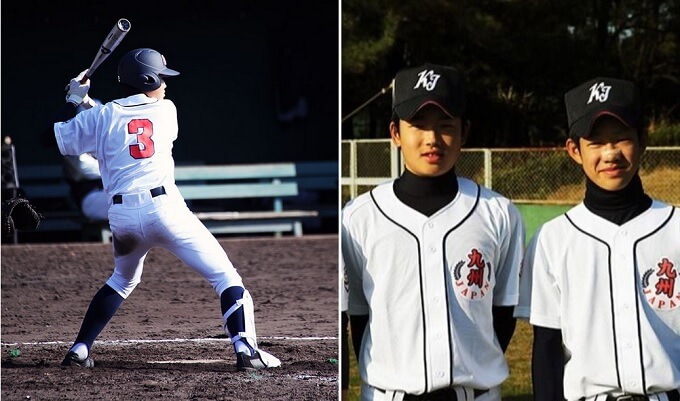
Munetaka naturally hit home runs one after another even during regular practice. The practice field had a right-field fence over 260 feet deep with a 30-foot-high net, but his hits easily cleared it. After repeatedly punching holes in the roof of a nearby shed, Mr. Yoshimoto, unable to bear it any longer, told him to aim for left-center field. Many middle schoolers try to pull the ball for home runs, but hitting it the opposite way isn't easy. At first, he could only make contact, but through repeated practice, by the summer of his third year, he could hit to all fields and hit home runs. Having made a sudden leap in growth in his third year of middle school, he followed Mr. Yoshimoto's advice and advanced to Kyushu Gakuin High School, a powerhouse baseball program.
Regarding Munetaka when he entered high school, Mr. Sakai, who was his coach at the time, said this: "I never saw him play in junior high. But the first time I saw him after he entered high school, I thought he would become a professional baseball player. Because even though he was big, he didn't rely on brute force. His bat swing started smoothly, and he had a swing where his head stayed still, rotating from the core.
Mr. Sakai started Munetaka as the starting first baseman from his freshman summer games. Despite being a freshman, he contributed to victory by hitting a grand slam home run in the Kumamoto Prefectural Tournament. However, he failed to get a hit at the national tournament in Koshien, and the team lost in the first round, leaving him feeling defeated. Consequently, Mr. Sakai switched him to catcher for the new team. He did so hoping Munetaka might become a hitting catcher like Kenji Jojima (former Major Leaguer).
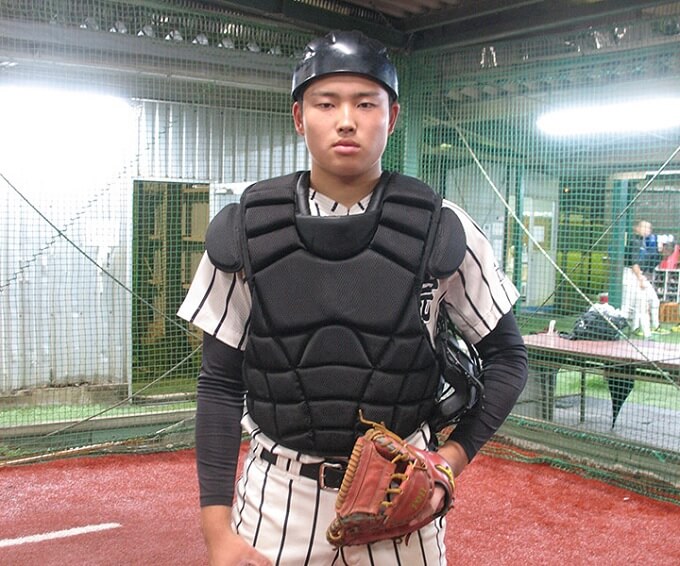
The catcher at Kyushu Gakuin High School not only catches the pitcher's throws but also checks the pitcher's form. This is because the coach cannot always be present in the bullpen to provide guidance. It is the catcher's role to closely observe the pitcher, relay any observations, and work together to make adjustments. Players who became catchers had to act as pitching coaches in the bullpen. As a result, Munetaka studied pitching, learned to identify each pitcher's characteristics and habits, steal timing, and anticipate pitch sequences after the first ball.
Although Munetaka began gaining experience as a catcher, his team failed to advance to the national tournament even during his sophomore year. However, in his final summer as captain during his senior year, he hit a go-ahead double in the third round and launched a home run to right-center field in the quarterfinals. They advanced all the way to the championship game but suffered a narrow defeat, falling short of reaching the national tournament at Koshien Stadium. After the game, he held back his tears, expressing gratitude to his teammates who fought alongside him and consoling the younger players.
Mr. Sakai remembered that day vividly. After the closing ceremony, everyone returned to school together. Even after the final meeting ended, he alone did not go home. Then, the tears he had held back began to fall. "I wanted to go to Koshien one more time with you, Coach," he said, and started crying loudly. To that, Mr. Sakai replied, "Munetaka, thank you. For you, this is just the beginning. Think about what comes next." Mr. Sakai spoke to him about the future. His extraordinary power hitting had caught the attention of professional scouts, and some called him "Higo's Babe Ruth." Higo was one of Japan's ancient provincial divisions, corresponding to present-day Kumamoto Prefecture.
At the draft meeting held on October 26, 2017, Munetaka was selected as the first-round pick by three teams. After a lottery, he was assigned to the Yakult Swallows. When asked about his professional goals, he commented, "I want to be a player who contributes to the team not only with home runs, but also with situational hitting like sacrifice flies and advancing runners. And someday, I want to play for the Japanese national team."
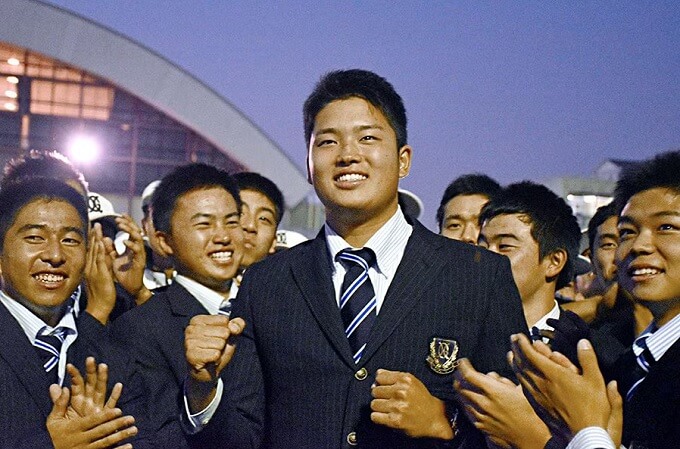
Munetaka debuted in the first team on September 16, 2018, his first year as a pro, and hit a home run to right field in his very first at-bat. He became only the seventh high school graduate rookie in history to hit a home run in his first professional at-bat. Although that was his only home run in his rookie year, he established himself as a regular in his second season. Playing third base, he made numerous errors but ultimately appeared in all 143 games, the only player on the team to do so. He hit 36 home runs (third in the league) and was awarded Rookie of the Year honors.
In 2020, he ultimately played in all 120 games, batting .307 (5th in the league) with 28 home runs (2nd in the league). His on-base percentage of .427, slugging percentage of .585, and OPS of 1.012 led the league. He continued hitting home runs in 2021, reaching 100 career home runs at the age of 21 years and 7 months, the youngest player ever to do so. Although he fell short of 40 home runs, he shared the home run title for the first time in his career with Kazuma Okamoto.
In 2022, Munetaka finished the first half of the season with a .312 batting average and 33 home runs. During the second half, from July 31 to August 2, he hit five consecutive home runs in five at-bats, an NPB first. Then, in the game on September 2, he reached 50 home runs for the season, becoming the sixth player to do so in 20 years since Hideki Matsui in 2002. He continued hitting home runs, tying Sadaharu Oh's Japanese professional baseball single-season record of 55 home runs on September 13 for the first time in 58 years. In his final at-bat of the season finale, he hit a home run, setting a new single-season record for a Japanese-registered player with 56 home runs.
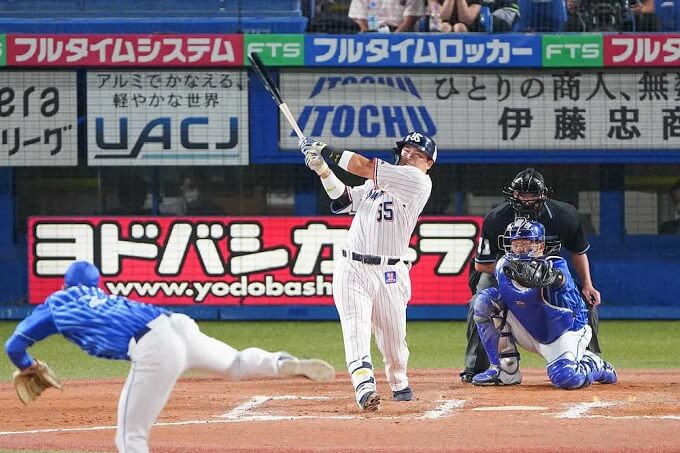
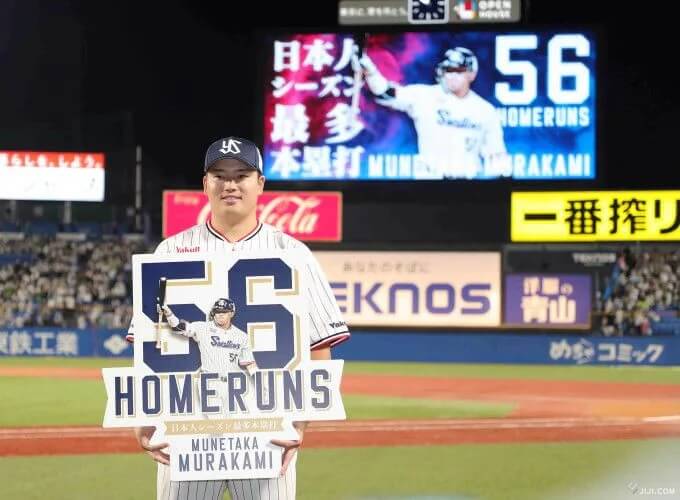
In 2023, he went without a title but posted 31 home runs (2nd in the league) and 84 RBIs (4th in the league). In 2024, he struggled early in the season but ultimately finished with 33 home runs and 86 RBIs, winning the home run title (his third time, first in two years) and the RBI title (his second time, first in two years), securing a double crown. After completing the second year of his three-year contract, he announced his challenge to MLB, stating, "I think 2025 will be my final season playing in Japan."
In 2025, he began practicing as a right fielder, but left camp on March 14 due to upper-body discomfort, delaying his return to action until July 8. Despite this, he hit 20 home runs for the seventh consecutive year. His posting process began on November 7 after the season ended. On December 21, 2025, he signed a two-year, $34 million contract with the Chicago White Sox, with the number 5 selected as his jersey number.
sources
- https://npb.jp/bis/players/41845136.html
- https://www.nikkansports.com/baseball/news/202210040000011.html
- https://diamond.jp/articles/-/344925
- https://www.yomiuri.co.jp/sports/npb/20221004-OYT1T50085/
- https://number.bunshun.jp/articles/-/842140?page=1
- https://www.sanspo.com/article/20240504-ON6PQ4CECJNQLHTQG67ONOMZRA/?outputType=theme_swallows
- Shohei Ohtani's early life
- Shohei Ohtani's high school days
- Shohei Ohtani's NPB career
- Yoshinobu Yamamoto's early life
- Shota Imanaga's early life
- Seiya Suzuki's early life
- Kodai Senga's early life
- Yuki Matsui's early life
- Shintaro Fujinami's early life
- Shinnosuke Ogasawara's early life
- Roki Sasaki's early life
- Tomoyuki Sugano's early life
- Munetaka Murakami's early life
- Kazuma Okamoto's early life
- Tatsuya Imai's early life
